Claudio Giulianelli
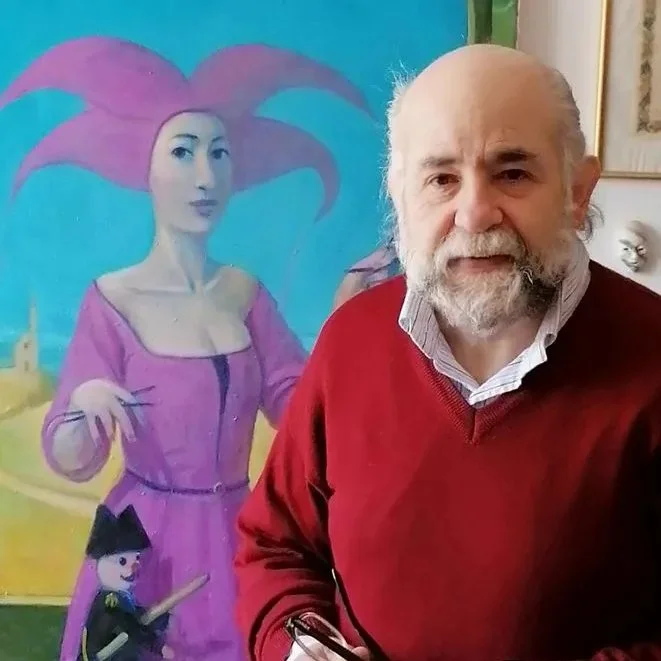
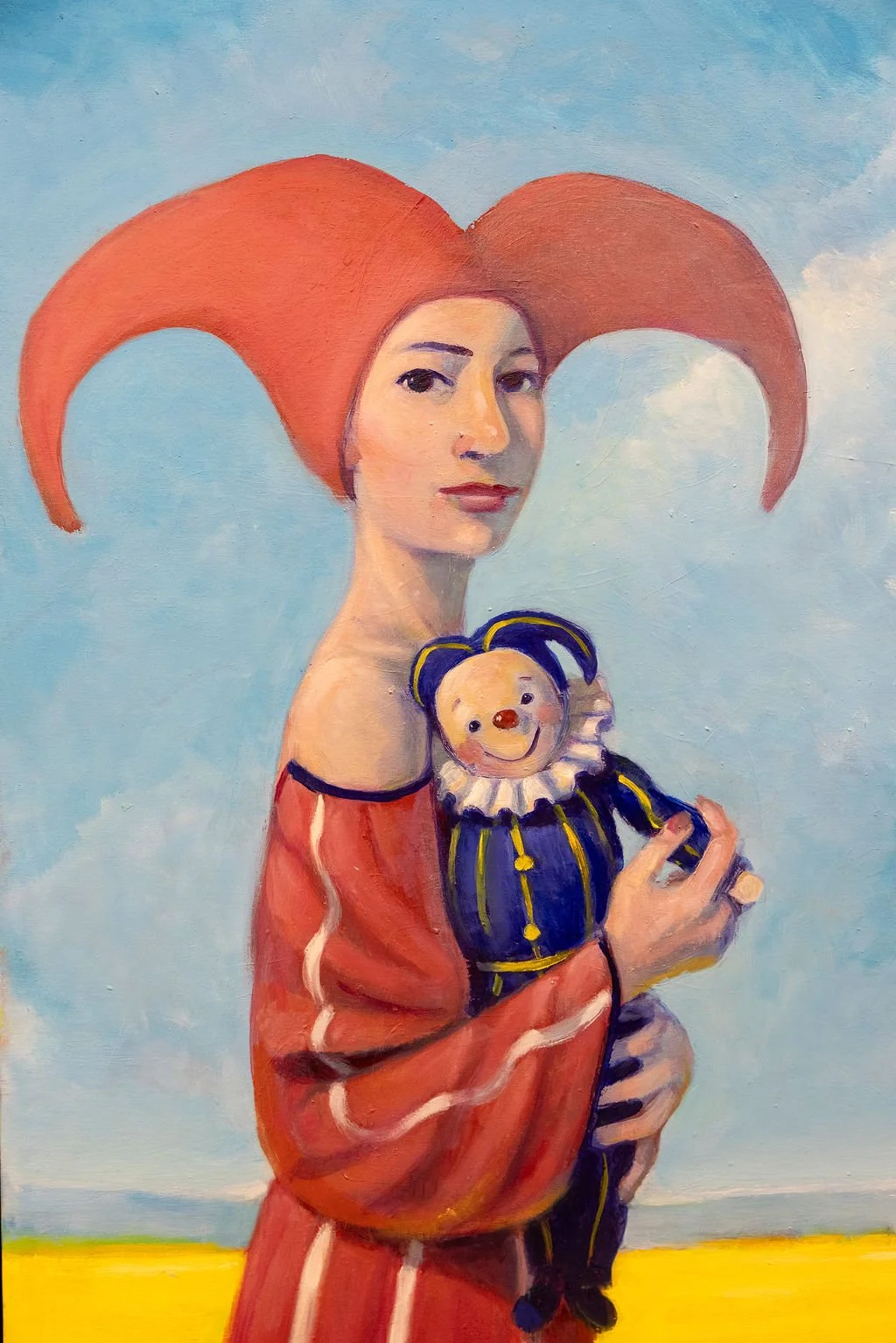
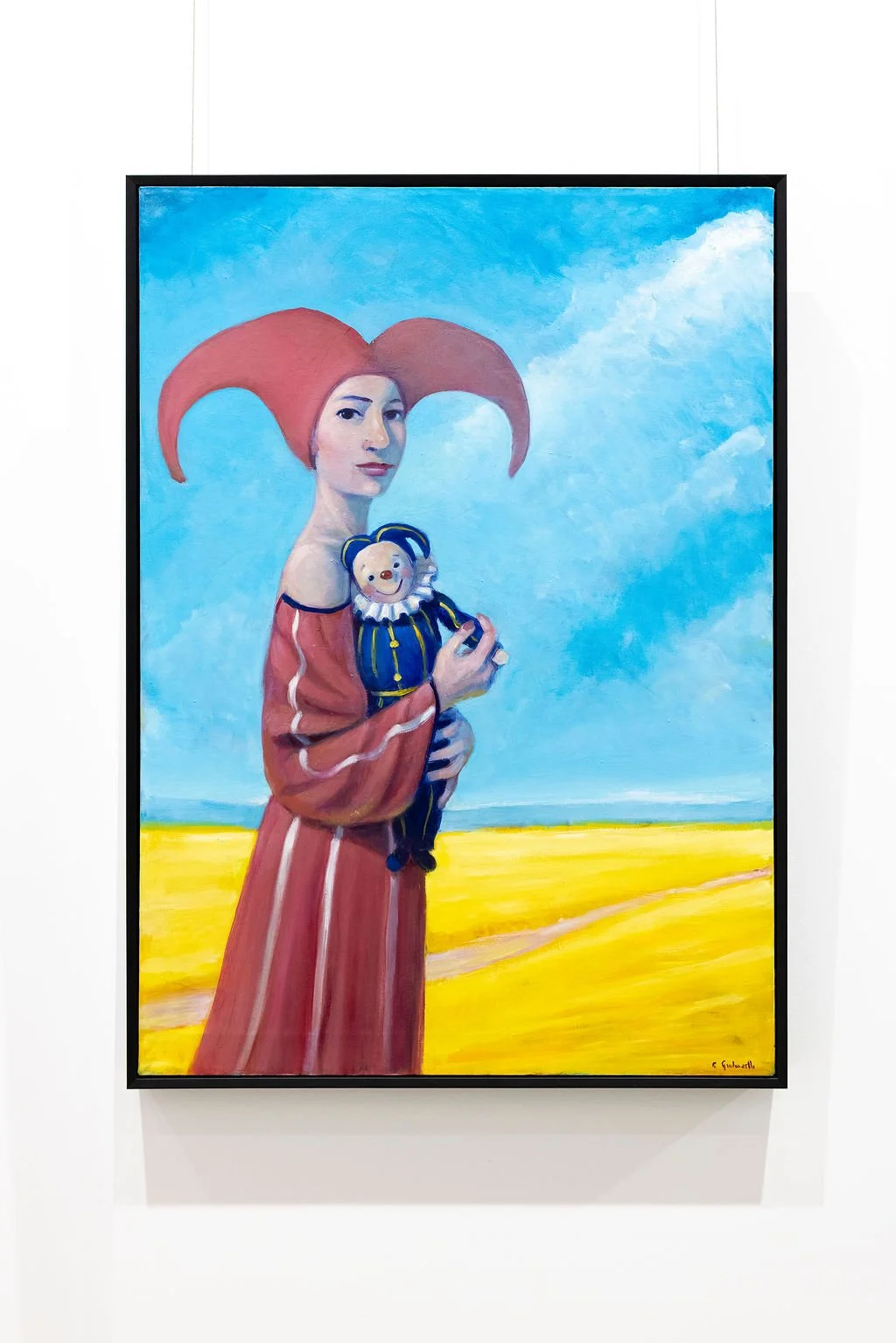
Claudio Giulianelli (b. 1956, Rome) is an Italian painter whose work conjures an invented, dreamlike Middle Ages. It is a world of veiled women, puppets, marionettes, and masks that Giulianelli renders in oil, channelling the meticulous technique of the Old Masters and saturating his canvases in the hermetic symbolism of medieval alchemy. Giulianelli describes his paintings as a tribute to "the Mysteries of Nature," built from a private vocabulary of recurring symbols: flutes and soap bubbles denoting harmony and the fragility of existence; suns and moons signifying masculine and feminine principles; the alembic, an alchemical distillation vessel, standing in for the whole of the natural world contained and transformed. Two recurring figures, Pulcinella, the anarchic trickster of the Commedia dell'Arte, and the Carabiniere, Italy's national police, appear throughout his work as embodiments of opposing energies, order set against instinct. For Giulianelli, meaning in art is neither fixed nor universally legible: "a work of art can be compared to a radio that emits waves at a multitude of frequencies," he has said. "The observer will perceive only those vibrations that are in harmony with... his soul." As he puts it more plainly: "the ant that is walking on the Mona Lisa does not know it is walking on the Mona Lisa."
Trained originally in chemical sciences, Giulianelli brings a scientist's precision to his materials, working in oil on canvas or panel, mixed at times with acrylic, using herbal-based thinner. He works entirely from imagination rather than photographic reference, having spent years studying anatomy through life drawing. Each canvas begins not with a sketch but with colour: two contrasting tones layered directly onto the raw surface until it dissolves into grey, a process of "dirtying" the canvas that he treats as a spontaneous rather than a planned act. "You don't paint with your brain," he says of this instinctive method.
Giulianelli's earliest memories of art are tied to two encounters. As a boy spending summers in Porto Ercole, Tuscany, he first heard local fishermen recount tales of Caravaggio. At age ten, a poster fragment of a Hieronymus Bosch painting on his classroom wall, a man with the face of a fish, struck him so forcefully that he initially mistook it for contemporary work; years later, encountering Bosch's Christ Carrying the Cross in person at El Escorial, Spain, he traces the moment his own style began to take shape. Giulianelli pursued his growing passion for art through the studios of established Roman painters rather than formal art school, immersing himself in the techniques of Caravaggio, the Flemish masters, Bosch, Van Eyck, Bruegel the Elder, and the Italian Baroque. Painters Delfo Previtali and Guido Razzi were early, formative influences on his technique, with Armando De Stefano and Alessandro Kokocinski among the contemporary Italian artists whose symbolic, philosophical approach to painting he most closely identifies with. In 1992, Giulianelli settled in Corchiano, a small town of ancient origin near Rome, where he continues to live and work, and where he co-founded Mega Art, an association and gallery supporting web-based artists, alongside a small painting school. He is a member of the Tota Pulchra Association, and has spoken of art as a means of communion with the divine.
Giulianelli has exhibited extensively across Europe, the Middle East, Asia, and the Americas for over four decades, with solo exhibitions in London, Brussels, Venice, Milan, Padua, San Gimignano, Volterra, Hangzhou, and Abu Dhabi, among many others, and inclusion in major art fairs in New York, Beijing, Istanbul, and Budapest. In 2012, his work was included in a presentation for the 54th Venice Biennale's Italian Pavilion, curated by Vittorio Sgarbi. He has undertaken artist residencies in Abu Dhabi and Ybbs an der Donau, Austria, and his religious commissions hang in churches across Italy and Austria. His work is held in museum and civic collections across Italy, Turkey, and the United States, and in the Palace of the Vatican, Rome, and his large-scale religious commissions hang in churches throughout Italy and Austria.